Introduction: Elections Amid a Prolonged Strategic Crisis
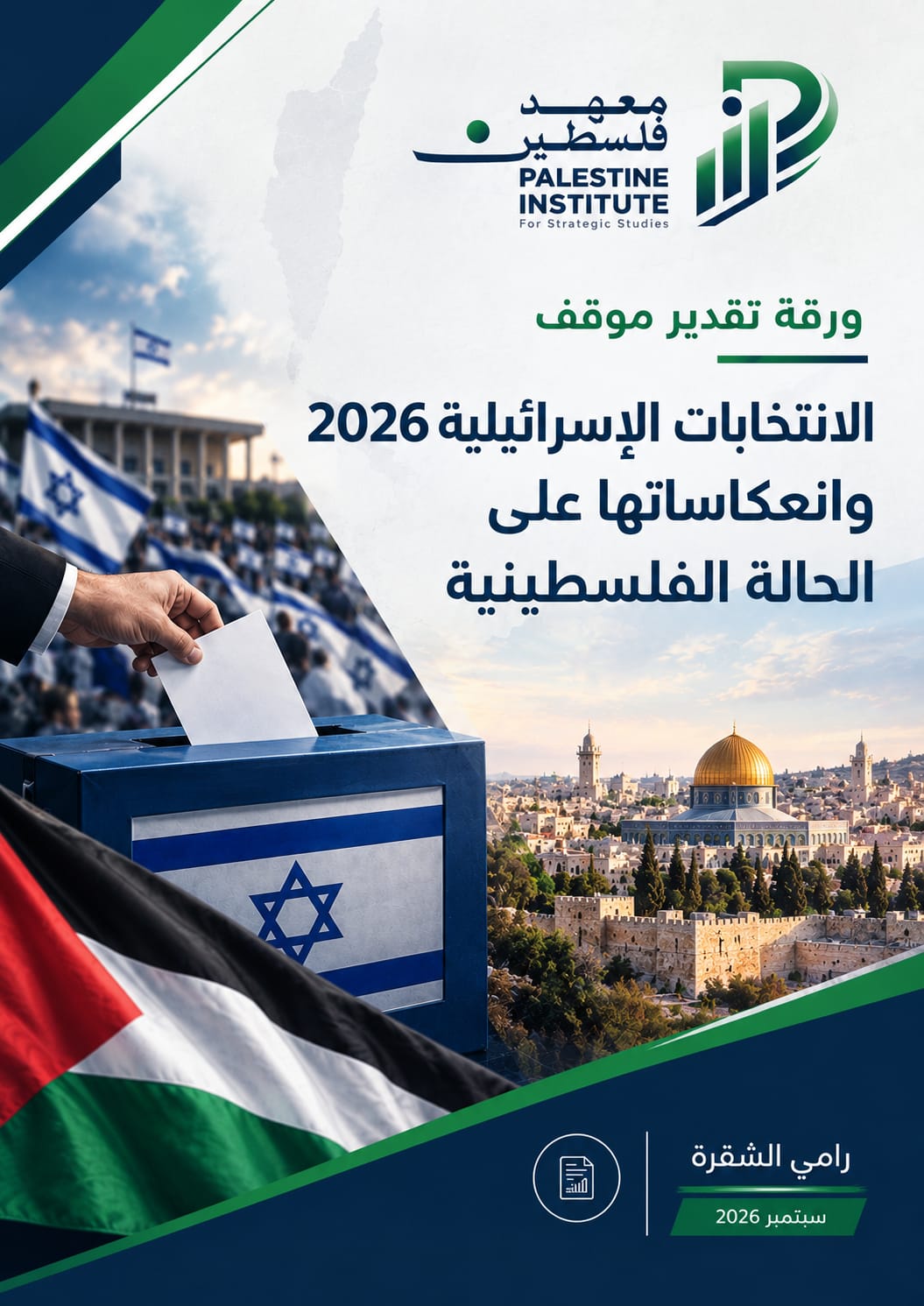
The 2026 Israeli elections are not taking place in an ordinary political environment, nor can they be read as merely a competition between Netanyahu’s camp and his opponents over forming the next government. The elections come at a moment when Israel is facing a complex test of its ability to restore deterrence, rebuild confidence in institutions, manage multiple fronts, and maintain social and economic cohesion, amid a regional environment that Israel, despite its military superiority, has failed to turn into an environment fully subject to its strategic will.
From this perspective, the October 27, 2026 elections appear closer to elections over the shape of the Israeli state after October 7, and the future of its security and political system, than to traditional elections between the right and the left. The question facing the Israeli voter is not only who will govern, but who can manage a state that has become more exposed to threats, more polarized, and more costly from a security and economic standpoint, and less certain about its ability to impose decisive political outcomes in the regional environment.
At the same time, the importance of the elections for Palestinians lies not only in the possibility of Benjamin Netanyahu leaving or remaining in office, but in determining whether political change in Israel will lead to a change in the nature of managing the Palestinian-Israeli conflict, or reproduce the same policies through different tools and faces.
The Strategic Environment: Israel Facing Unresolved Fronts
Israel entered the elections carrying the heavy legacy of the war that has continued since October 7, military operations in Gaza, ongoing tensions on the Lebanon and Syria fronts, the escalation related to Iran, in addition to the transformations that have affected the maritime and regional environment, particularly in the Red Sea and Bab al-Mandab.
Here, an important strategic paradox emerges. Israel has managed to inflict significant military damage on its adversaries, but it has not succeeded to the same extent in translating military superiority into complete strategic control over its surrounding environment. Iran has been subjected to major military strikes, but it has not been removed from the regional equation, and it still possesses pressure tools capable of affecting security, energy, and navigation. The continuation of tensions around the Strait of Hormuz also makes one of the world’s most important energy corridors part of the regional conflict, raising the cost of the war for the Israeli and Western economies.
On the other hand, Bab al-Mandab represents a geopolitical and economic transformation that should not be treated merely as a security threat to ships. The Houthis have accumulated an increasing ability to influence one of the world’s most important maritime corridors, which affects trade flows, insurance and transportation costs, supply chains, the Port of Eilat, and Israel’s ability to reach Asian markets through traditional maritime routes.
Thus, Israel has found itself facing two simultaneous geo-economic chokepoints: Hormuz in the Gulf and Bab al-Mandab in the Red Sea. This means that Israel’s strategic environment is no longer governed solely by its land borders or its ability to achieve air and missile superiority, but also by its ability to protect the flows of energy and trade in a highly turbulent regional environment.
As for Lebanon and Syria, they do not represent fronts separate from this picture. Developments along the northern border, the Israeli military presence, and attempts to reshape the security environment in southern Lebanon and Syria confirm that Israel is still dealing with the region through the logic of creating security belts, spheres of influence, and advanced deterrence, rather than moving toward a stable regional environment.
All of this places the next Israeli government before a fundamental dilemma: How can security and deterrence be achieved in an environment where sources of threat are expanding, fronts are overlapping, and complete military victory cannot be achieved?
Netanyahu May Lose the Elections, but His Strategic Legacy Does Not Lose the Elections with Him
Netanyahu represents one of the most important variables in the upcoming elections, but at the same time, he is one of the elements that must be approached with the greatest caution against exaggerating its importance. Netanyahu’s departure from power, if it occurs, does not necessarily mean the departure of the ideas and policies that have become entrenched during his years in office.
Netanyahu has contributed to reshaping Israeli policy toward the Palestinian issue on the basis of managing the conflict rather than resolving it, weakening the prospects for a political settlement, strengthening the position of right-wing and religious forces, and expanding the scope for dealing with the West Bank as an arena for the gradual determination of sovereignty and control.
Therefore, the Palestinian challenge does not lie in the question of whether Netanyahu will remain, but in whether the forces that may replace him will reconsider this direction or reproduce it in a more institutional manner and with less confrontation with the international community.
Eizenkot, for example, may be more capable than Netanyahu of rebuilding trust between society and the security establishment, and may be more acceptable to segments of the Israeli center, but he is not necessarily more prepared to recognize Palestinian national rights. Likewise, the rise of a center or more moderate right-wing government in its rhetoric does not automatically mean a transition toward a political settlement. As has been said, the politician may change, but the direction of the structure does not change at the same speed.
Israeli Society: A Crisis of Trust More Than a Shift Toward a Settlement
The elections reveal an Israeli society experiencing a deep crisis of trust in leadership and institutions, particularly following the failures of October 7, the costs of the war, and the continuation of political and social polarization.
September polls show that security and foreign policy, accountability for October 7, and the cost of living are among the most prominent issues affecting voter behavior. This is important because it means that a fundamental part of the electoral competition revolves around who can rebuild the sense of security and governmental competence.
However, there is insufficient evidence that this internal shift means a broad shift toward recognizing Palestinian national rights or accepting a final settlement to the conflict.
Therefore, three things must be distinguished:
- A change of government does not mean a change of policy.
- Ending a particular war does not mean ending the conflict.
- Rebuilding Israeli democracy does not necessarily mean recognizing Palestinian national rights.
Hence, the Palestinian reading of the elections should not begin from the binary of “Netanyahu or the alternative,” but from a deeper question: What will remain constant in Israeli strategy regardless of the identity of the prime minister?
The West Bank: From Occupation Management to a Project of Determination
The West Bank represents the most important arena in reading the post-election period. While Gaza has occupied the center of military and political attention over the past years, the West Bank has witnessed an increasing trajectory of settlement expansion, changes in the rules of control, expanded powers for settlers and Israeli civilian institutions, alongside a shrinking distance between military administration and settlement policy.
Here, the idea of “determination” emerges as more than merely a political slogan. It expresses a direction seeking to transform Israeli control from a reality that can be negotiated into a permanent institutional reality.
If Israel faces difficulty achieving strategic determination in the regional environment, the West Bank may become more important as the arena where results that are more capable of being consolidated can be achieved. Therefore, the possibility of the center of gravity shifting from Gaza to the West Bank after the elections should be among the most important assumptions for which the Palestinian leadership prepares.
The danger lies not only in an official declaration of annexation, but in a gradual functional, legal, and geographic annexation that makes a political declaration at a later stage merely a consolidation of a reality that has already been built on the ground.
Gaza: The End of the War Does Not Mean the End of the Issue
Even if major military operations in Gaza come to an end, this will not mean the end of the conflict. Gaza will remain connected to three main questions: Who will govern? Who will rebuild? And who will guarantee security?
These questions will not be Palestinian alone; they will become part of the Israeli, regional, and international competition over the shape of the next Palestinian system.
A new Israeli government may attempt to move from the model of open warfare to a more manageable model: security containment, interim arrangements, political and economic pressure, and redefining the relationship with Gaza without returning to a comprehensive political settlement.
Here lies one of the most dangerous assumptions: that the transition from war to something resembling calm could become an alternative to addressing the roots of the conflict.
The Seven Scenarios: What Comes After the Elections?
Scenario One: Netanyahu Remains and the Project of Determination Is Reproduced
The first scenario is Netanyahu remaining in office and reproducing the project of determination. In this case, the current trends in the West Bank are likely to continue, the use of pressure tools may escalate, and the priority of security and war may be maintained, with increased possibilities of confrontation with the Palestinians. The likelihood of this scenario increases if Netanyahu’s camp manages to overcome the current crisis in the numbers and transform security polarization into electoral votes.
Scenario Two: A Government Led by Eizenkot
The second scenario is the formation of a government led by Eizenkot. This scenario would likely mean rearranging the relationship between the political leadership and the security establishment, attempting to restore confidence in the state, and rebuilding external alliances. However, this does not guarantee a fundamental shift toward the Palestinians. Such a government may be more rational in managing the conflict, but not more prepared to end it.
Scenario Three: The Rise of Bennett or a New Center-Right Coalition
The third scenario is the rise of Bennett or a new center-right coalition. This direction may seek to reduce the cost of the conflict and reorder economic and security priorities, while maintaining a significant degree of Israeli control over the land. Thus, the objective would become managing the conflict more efficiently, rather than settling it.
Scenario Four: A National Unity Government
The fourth scenario is a national unity government emerging as a result of the inability to form a stable coalition. It may lead to consolidating the Israeli security consensus, particularly on issues related to Iran, Gaza, Lebanon, and the West Bank, while temporarily reducing the intensity of the internal conflict.
Scenario Five: A Coalition Crisis and a Return to Elections
The fifth scenario is a coalition crisis and a return to elections. This scenario does not necessarily mean a political vacuum, but it may weaken the ability to make long-term strategic decisions and push the government toward short-term measures of an electoral nature.
Scenario Six: The Shift of the Center of Gravity to the West Bank
The sixth scenario is the shift of the center of gravity to the West Bank. This could occur regardless of the identity of the government if de facto annexation, settlement expansion, violence, and the erosion of the Palestinian Authority’s ability to perform its functions increase. In this case, the West Bank becomes the arena most likely to witness a broad Palestinian Israeli explosion.
Scenario Seven: A Regional Reshaping of the Conflict
The seventh scenario is a regional reshaping of the conflict, such that the Palestinian issue is no longer separate from the competition over Iran, the Gulf, Hormuz, the Red Sea, Lebanon, and Syria. In this scenario, Israel becomes part of a broader regional security system, and Palestinians face the risk of their issue being treated as a security file within regional arrangements, rather than as a national liberation issue and a matter of political rights.
The Most Likely Composite Scenario Through the End of 2027
It is unlikely that any of the seven scenarios will materialize in its pure form. The most likely scenario is a partial change in leadership with the continuation of the essence of the strategic environment.
Any government that comes to power will find itself facing a society more sensitive to security, a more influential security establishment, a more entrenched right, advanced settlement realities, open regional fronts, and an economy bearing increasing security costs.
Accordingly, the greater possibility is that, through the end of 2027, we will witness a redefinition of conflict management rather than an end to the conflict, with a gradual and greater shift toward the West Bank, an attempt to consolidate post-war arrangements in Gaza, and continued pressure on the Palestinian Authority, alongside a reordering of the regional front.
Implications for the Palestinian Situation
The fundamental danger lies in the possibility that Palestinians may read the elections as an opportunity to change the Israeli government, while Israel reads them as an opportunity to rebuild the state and its instruments of power.
This difference in reading can be costly. If Israel moves into the post-Netanyahu phase without a fundamental review of the project of control over the land, the Palestinian leadership may find itself facing a more stable and effective Israeli government in implementing policies of gradual annexation. If Gaza becomes secure without a political settlement, calm may turn into a tool for reproducing Palestinian geographic and political fragmentation. If the regional crisis continues, attempts may increase to integrate the Palestinian issue into regional security and economic arrangements that do not necessarily respond to the essence of Palestinian national rights.
Therefore, the Palestinian response should not be to wait for the election results, but to prepare for what comes after them.
Conclusion
The 2026 Israeli elections are not an endpoint, but a point of transition. Perhaps the most important Palestinian strategic mistake would be to reduce them to the question: Will Netanyahu remain or leave?
The more important question is: What will Israel do after the elections in a regional environment it has been unable to determine, within a society seeking to restore security and trust, and on Palestinian land where the realities of annexation and control are accelerating?
Netanyahu may leave, but his legacy may remain. The government may change, but security will remain the central determinant of Israeli policy. A war may end, but the conflict will continue through other tools.
Therefore, the most dangerous possibility for Palestinians is not necessarily Netanyahu’s remaining in power, but Israel’s success in producing a new government that is more capable of managing the project of control and determination without having to abandon it. It is precisely here that the 2026 elections shift from an internal Israeli matter into a strategic variable in the future of the Palestinian situation.