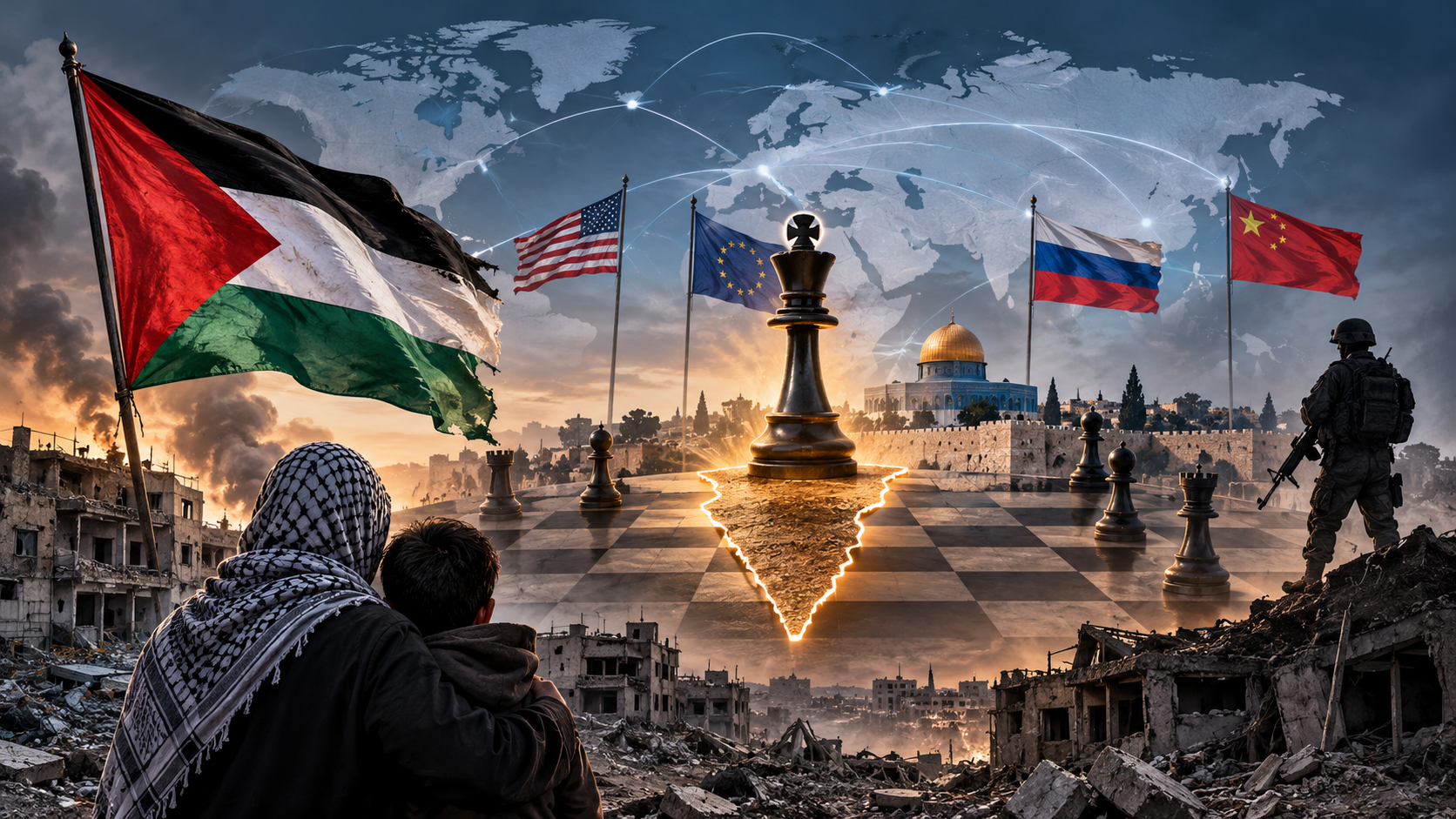
The strategic significance of the trilateral summit that brought together U.S. President Donald Trump, Chinese President Xi Jinping, and Russian President Vladimir Putin in the Chinese city of Shenzhen lies not merely in the meeting of leaders of three major nuclear powers, but rather in the implications of its convening at a moment when economic competition intersects with military conflicts, and the capacity of international institutions to contain crises is declining. The central question is not whether the summit achieved a diplomatic breakthrough, but whether it represents the beginning of a transition from open competition to a more systematic management of disagreements among major powers, and what this may entail for the international order, the Middle East, and the Palestinian cause.
Perhaps, in the view of many observers, the meeting went beyond symbolism and reached a level closer to political understanding, as the three presidents issued a joint declaration entitled: “Declaration of the Presidents of the United States, Russia, and China Toward Peace.” The declaration included commitments to reform the United Nations, enhance the stability of energy supplies, respect the immunities of state officials, and warn against the misuse of the jurisdiction of the International Criminal Court, in addition to launching dialogue on reducing nuclear risks and preventing nuclear proliferation. Nevertheless, the declaration lacked any detailed implementation commitments or specific timelines, and did not present an announced settlement to the war in Ukraine, the U.S.-Iran confrontation, or the issue of Israeli attacks against its neighbors in the region.
Accordingly, the summit may represent a breakthrough in the level of political communication, but it has yet to demonstrate the existence of a comprehensive strategic consensus. Understanding the necessity of avoiding nuclear war does not mean agreement on managing conventional wars, just as calling for reform of the international order does not imply agreement on the nature of such reform or the distribution of its gains.
Here, it is worth noting that the most likely scenario is that the three parties are seeking, to varying degrees, to contain the risks of competition without relinquishing its instruments. The United States seeks to maintain its leadership position and prevent competition with China from turning into a confrontation that would be difficult to contain; China seeks to consolidate its position as an international power capable of influencing the rules of the global order; while Russia is leveraging its participation to reaffirm its continued presence in international security equations, despite the pressures associated with the war in Ukraine.
Accordingly, Beijing may have achieved an important diplomatic gain without incurring direct costs related to the substantive issues at stake, through hosting the meeting, as it appeared as a party capable of bringing Washington and Moscow together at the same table. The value of this gain is measured not merely by its symbolism, but by China's ability to transform its diplomatic position into negotiating leverage in matters of trade, technology, energy, and international security.
Herein lies the advantage of the Chinese approach, in its ability to combine the expansion of economic partnerships with the strengthening of strategic autonomy, without necessarily committing to a closed military or political alliance. Therefore, hosting the summit should not be interpreted as sufficient evidence of the transfer of the center of global hegemony to Beijing, but rather as an indicator of its expanding ability to influence the management of international competition.
In contrast, Washington still possesses extensive economic, military, and alliance-based instruments, while Moscow retains influential capabilities in the fields of energy, deterrence, and security. This, in turn, confirms that the most likely landscape is not a complete transfer of hegemony from one power to another, but rather the emergence of an asymmetric multipolarity, in which instruments of power and influence are distributed differently.
Here, it can be argued that the summit declaration carries implications regarding increased production and supply of refined petroleum products that extend beyond the energy sector; it reflects a shared recognition of the importance of economic flow stability in limiting the risks of competition.
Consequently, the absence of targeted quantities and implementation mechanisms prevents the conclusion that the leaders have agreed on joint management of energy markets or on guaranteeing lower prices.
Similarly, diplomatic rapprochement does not necessarily mean the end of U.S.-Chinese competition in technology, trade, and supply chains. Rather, cooperation in areas of mutual benefit is more likely to continue, in parallel with tightening restrictions in sectors related to national security and technological superiority.
In my view, this model of selective interdependence enables major powers to achieve mutual economic gains without relinquishing strategic competition. At the same time, it may place additional challenges before states with limited room for maneuver, particularly those dependent on external sources for energy, technology, financing, and armament.
Consequently, a single summit is insufficient to speak of a “New Yalta” or an agreement to divide the world into spheres of influence, as the declaration did not include arrangements of this kind, nor did it establish any consensus on settlements to the war in Ukraine or the issues of East Asia and the Middle East.
However, it is worth noting that the meeting may open the door to the possibility of developing a pattern of crisis management among major powers based on direct negotiations over shared risks, while competition continues in other areas. This pattern of mutual understandings and common approaches may reduce the likelihood of direct confrontation, but it does not guarantee the end of existing conflicts or the addressing of their underlying causes.
Naturally, the dilemma of international legitimacy emerges here. The call for reform of the United Nations may reflect a genuine need for institutions better equipped to respond to crises. However, emphasizing the immunities of state officials and warning against the misuse of international jurisdiction raise questions regarding the balance between sovereignty and accountability. The declaration, in itself, does not entail any annulment of the legal jurisdiction of the International Criminal Court.
Therefore, the benchmark for change will not be political rhetoric alone, but rather the extent to which the three powers are willing to develop practical mechanisms to reduce escalation, respect international commitments, and apply legal rules without double standards, while obliging all parties to the conflicts in our region to comply with international and humanitarian law, enforce United Nations resolutions, and uphold the decisions of the International Criminal Court as a judicial body concerned with the application of international law.
It is also worth noting, regarding our region, that the Middle East has become one of the most important practical tests of any understanding between Washington, Beijing, and Moscow, given its connection to energy security, maritime routes, and regional balances.
In my view, the summit may offer opportunities for de-escalation if communications are translated into implementable understandings concerning Iran and Gulf security. However, the declaration did not present an agreement of this kind, and this remains contingent upon the diplomatic pressure exerted by the countries of the region.
As for Israel, as a major player and a key party to the escalating conflicts in the region, containing regional confrontations may reduce the risks of a wider war for Israel. However, this may not necessarily mean a change in the U.S. position toward Israel or the emergence of new substantive restrictions on its policies. This will remain linked to Washington's positions, regional balances, and any subsequent understandings.
Accordingly, in the Palestinian context, the declaration contains no explicit commitment regarding Gaza, ending the occupation, or advancing toward the establishment of a Palestinian state. This is a point that should not be overlooked, as consensus among major powers on the stability of the international order does not guarantee that Palestinian justice will be part of the priorities of this stability. This is an issue that does not inspire confidence among the peoples of the region and places a significant responsibility on the shoulders of its states.
This does not mean that opening the door to improved relations among major powers will not lead to humanitarian and political understandings concerning a cessation of the war, aid, and reconstruction. Such outcomes may materialize if political will and implementation mechanisms are available, driven by the countries of the region. However, I believe that the alternative possibility, namely the consolidation of temporary arrangements to manage the crisis without addressing its political roots, will remain present, making de-escalation an alternative to ending the occupation and achieving self-determination.
Accordingly, it is necessary to point out that any approach that practically expands the scope of immunities at the expense of accountability will likely weaken the political environment supportive of enforcing international law, although the declaration itself does not alter the legal status of the International Criminal Court or its decisions.
Accordingly, the direction of the coming phase can be anticipated through the assessment of three main trajectories over the short term. The first, and most likely trajectory, involves the continuation of dialogue and limited cooperation among the three powers, while competition and conflicts remain unresolved comprehensively. The second is the possibility that the summit develops into partial understandings on certain issues, allowing for de-escalation and opening additional diplomatic opportunities. The third involves the breakdown of dialogue and the continuation of military and economic escalation, thereby reducing the summit's impact to its symbolic limits.
The distinction between these trajectories will depend on practical indicators, most notably the regularity of nuclear dialogue, the emergence of verifiable initiatives concerning Ukraine and Iran, the translation of the energy declaration into implementing measures, and the emergence of specific proposals for reforming the United Nations. As for the Palestinian file, the decisive indicator remains the extent to which any subsequent understandings are linked to ending the war, ensuring aid, preventing forced displacement, ending the occupation, and preserving the unity of the Palestinian political sphere.
In conclusion, the Shenzhen Summit reveals an increasing recognition among major powers that managing competition has become a necessity to avoid risks that no party can contain on its own. However, it does not prove the establishment of a new international order, nor does it guarantee the settlement of conflicts that threaten its stability.
Moreover, the success of major powers in managing their disagreements does not necessarily equate to the success of the international order in achieving just peace. The risks of direct confrontation among them may decline, while conflicts involving states and societies with less capacity to influence power arrangements continue.
From a Palestinian perspective, the summit should not be assessed based on the extent of consensus among Washington, Beijing, and Moscow, but rather on whether this consensus will contribute to ending the war and occupation and achieving self-determination, or whether it will merely manage the crisis within arrangements that preserve the interests of major powers. The strategic distinction is not between a world in which major powers compete and another in which they reach understandings, but rather between an understanding that opens the way to just settlements and one that manages conflicts without eliminating their underlying causes.